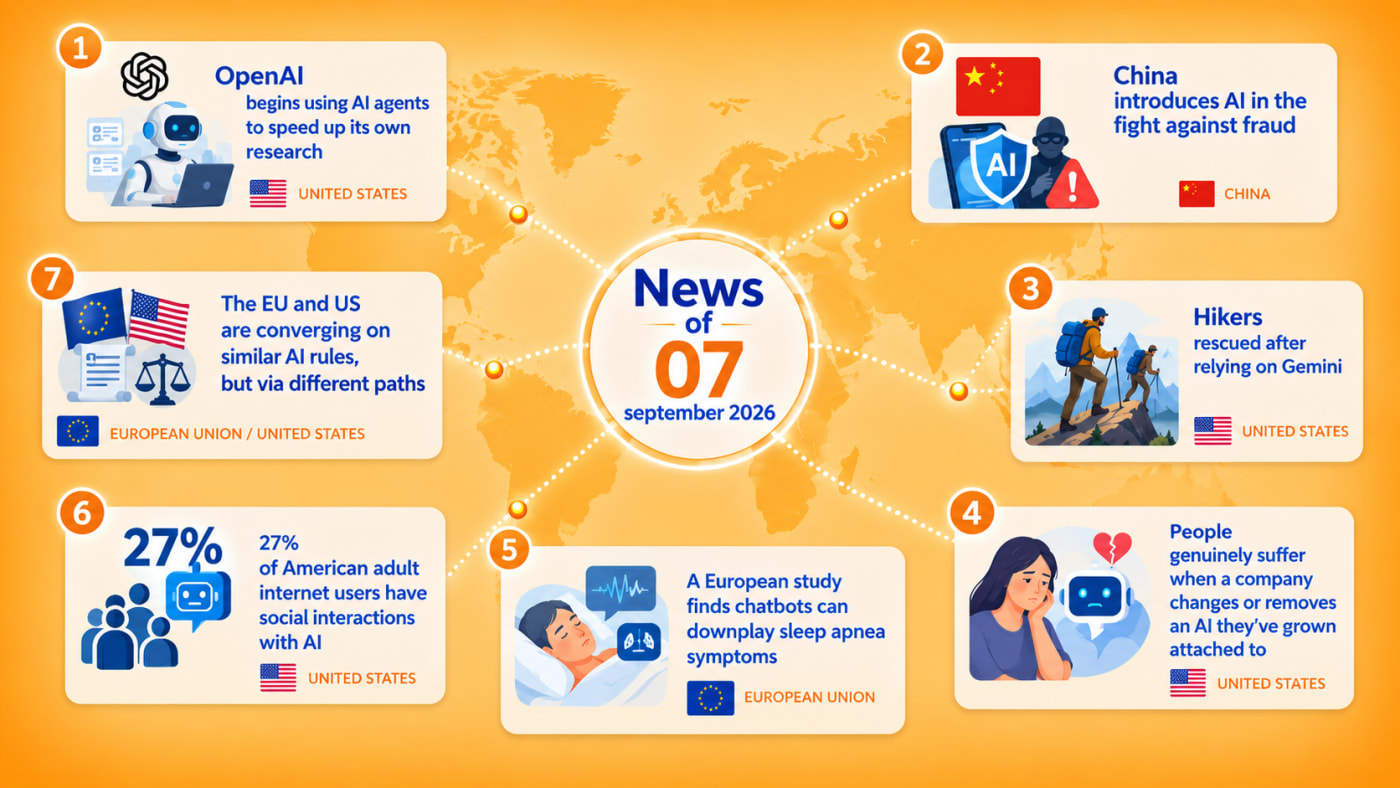
OpenAI begins using AI agents to speed up its own research
OpenAI says coding agents have become part of its researchers' daily work, and their use grew rapidly in 2026. The company states that by mid-August, its research organization was using the equivalent of 3.1 days of agent work for every day of human work. Researchers use agents for writing code, debugging, infrastructure, evaluations, and running experiments, and the tasks being delegated are gradually becoming more complex.
Why it matters: this points to one of the most interesting shifts in the industry: AI is no longer used just to build products for users, but is starting to be used to accelerate the very process by which the next generations of AI are developed. OpenAI says it has reached the goal of having an automated "research intern" capable of executing well-defined research tasks under human guidance, and is aiming to build a fully automated AI researcher by 2028. Researchers still set the priorities and decide which results are worth pursuing, but the volume of work carried out by agents is growing fast.
China introduces AI in the fight against fraud
China has launched an app based on artificial intelligence aimed at combating phone and online fraud. The system is designed to help users identify scam attempts and recognize warning signs in digital interactions. The launch is part of Chinese authorities' efforts to use technology to protect the population against a wide range of digital fraud.
Why it matters: it's a simple but relevant example of how AI can become a tool of everyday protection. Instead of being used only to generate text or images, an AI system can analyze the information a user receives and warn them before they send money or personal data. At the same time, such systems raise questions about privacy and how much people should rely on automated risk assessment.
Hikers rescued after relying on Gemini
Three inexperienced hikers were rescued after relying on Google Gemini to plan a climb of Mount Shasta, California. According to local authorities, the group received route and supply recommendations from Gemini and set out with too little food and water for a situation where the hike ran long. What was supposed to be roughly an eight-hour climb turned into a situation requiring rescue teams. One of the hikers injured their knee during the descent, and the group ended up stranded overnight.
Why it matters: the incident highlights one of the most important limitations of chatbots: an answer can sound very convincing even when the information isn't reliable enough for a real-world situation. Authorities in Siskiyou County warned that AI should not be used as the sole source for planning a mountain hike and recommend checking information with local rangers and using multiple navigation methods. The problem isn't just that AI can be wrong — it's that users can place too much trust in an answer delivered with confidence.
People genuinely suffer when a company changes or removes an AI they've grown attached to
A study published in Nature Human Behaviour shows that some people can experience a real sense of loss when a chatbot they've become attached to is modified or has certain features removed. Researchers analyzed 54,861 posts from communities dedicated to Replika and ChatGPT, plus data from 1,452 participants across seven surveys. Both the removal of Replika's erotic role-play feature and the launch of GPT-5 were associated with more expressions of sadness, loss, and a desire to return to the previous version.
Why it matters: for some users, a chatbot has become more than just a piece of software. Researchers found cases where Replika users reported feeling closer to the chatbot than to certain human relationships. This creates a new problem: unlike a friend or partner, an AI can be modified, replaced, or removed by the company that runs it. For the user, though, a model change can feel like the loss of a relationship.
A European study finds chatbots can downplay sleep apnea symptoms
A study presented at the European Respiratory Society Congress in Barcelona examined how AI chatbots respond to people describing symptoms of obstructive sleep apnea. Researchers found that in about a third of cases, chatbots gave responses that could downplay the severity of symptoms and discourage seeking a specialist medical evaluation. Sleep apnea is linked to risks such as high blood pressure, stroke, cardiovascular disease, and type 2 diabetes.
Why it matters: more and more people are using chatbots as a first step when they notice a symptom and want to know if it's serious. The problem arises when an AI response reassures someone in a situation where seeing a doctor would have been more appropriate. The study doesn't mean chatbots are useless for health matters, but it shows why they should be treated as information tools, not substitutes for medical evaluation — especially when symptoms are persistent or potentially serious.
27% of American adult internet users have social interactions with AI
A survey by Elon University's Imagining the Digital Future Center found that 27% of American adult internet users have significant social or emotional interactions with AI systems such as ChatGPT, Gemini, Claude, or Copilot. According to the research, about a third of these users consider the chatbot a friend, and people use AI not just for information but also for personal conversations, relationship advice, entertainment, or companionship when they're alone.
Why it matters: the figure shows how quickly the role of chatbots is changing. For millions of people, AI is no longer just a productivity tool — it's becoming a space where they express emotions, ask for advice, and seek companionship. The connection to the study on chatbot loss matters here: if people are building emotional relationships with AI, then modifying a model, changing its personality, or discontinuing a service can have real psychological effects.
The EU and US are converging on similar AI rules, but via different paths
Henna Virkkunen, European Commission Vice-President for Tech Sovereignty, Security and Democracy, argues that the differences between the European and American approaches to AI regulation are smaller in practice than they appear at first glance. While the EU tries to set rules in advance through the AI Act and the Digital Services Act, the United States is arriving at similar rules through state legislation, lawsuits, and legal settlements. The statement comes after the G20 summit, where the US administration promoted the Carolina Principles and argued against creating new AI regulatory structures.
Why it matters: for ordinary users, the difference between the two models might seem abstract, but it will directly affect how chatbots operate. In Europe, ChatGPT was designated by the European Commission as a "Very Large Online Search Engine" (VLOSE) under the DSA, after reporting more than 45 million average monthly users in the EU. As a result, OpenAI now has new obligations to assess and mitigate systemic risks, including those related to physical and mental well-being, minors, fundamental rights, and public security.
Sources
- OpenAI – Research acceleration: The view inside OpenAI
- China Daily – China launches AI-powered app to combat telecom and online fraud
- TechCrunch – Hikers rescued after using Google Gemini for planning
- Los Angeles Times – Hikers stranded on Mt. Shasta after following Gemini's plan
- Nature Human Behaviour – Mourning the loss of AI companions
- European Respiratory Society – AI chatbots and sleep apnea
- Elon University – The Rise of AI Companions
- European Commission – ChatGPT, Reddit, and Roblox under the DSA
- The Next Web – EU tech chief says AI guardrails are coming to the US anyway


Comments
Comments are moderated before publication.
No approved comments yet.